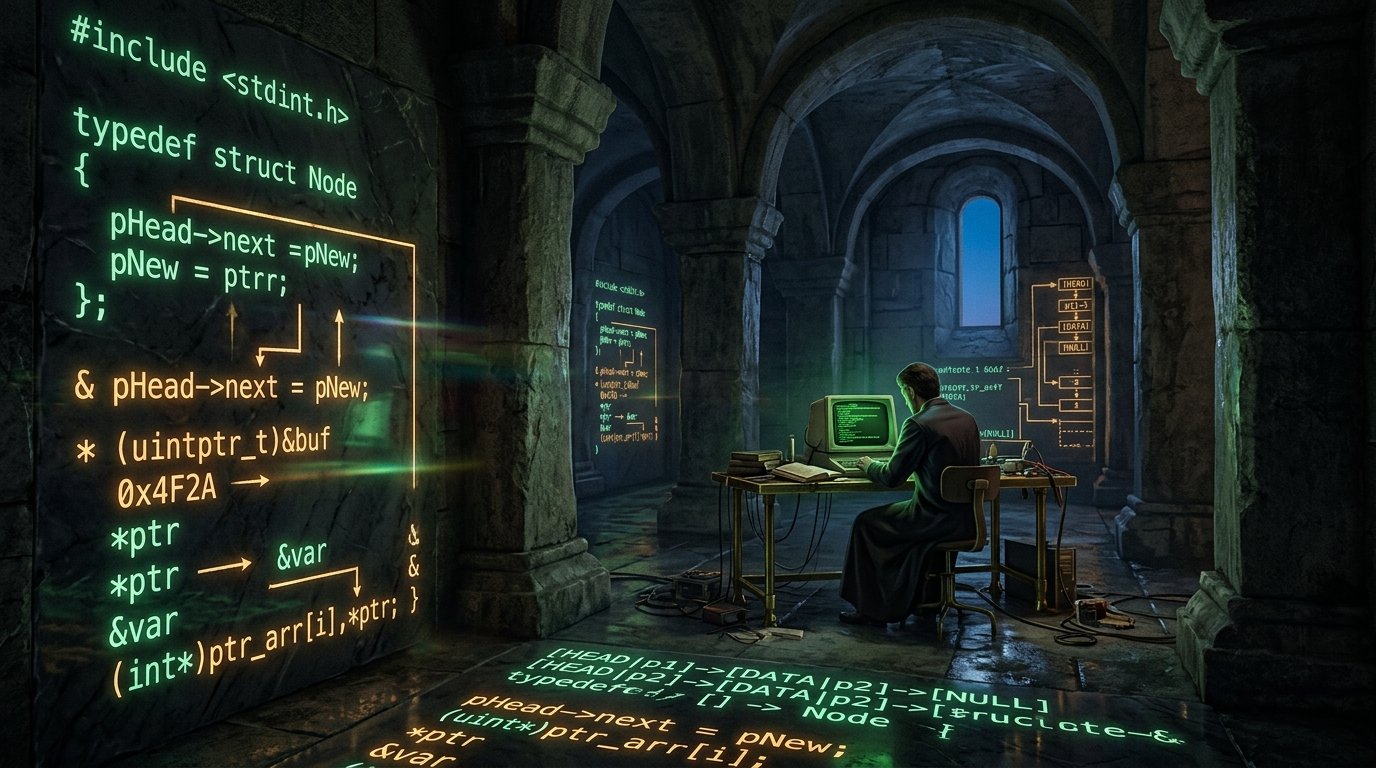
C is more than fifty years old, and it is still underneath almost everything that matters. Every router, kernel, database engine, embedded controller, scripting-language runtime, and hypervisor speaks it fluently. While higher-level languages promise speed of thought, C remains the speed of metal. That is why we are opening the C Systems Lab, a new Liberpulse series that teaches C17 from the bytes up.
A language older than the web, still holding it up
C was forged in the early 1970s at Bell Labs as a systems implementation language for Unix. Its design philosophy is radical simplicity: map cleanly to hardware, trust the programmer, and get out of the way. That simplicity is why the Linux kernel, the Python interpreter, the SQLite engine, the Redis server, and countless bootloaders and firmware images are still written primarily in C. The language has been standardized multiple times, with C11, C17, and C23 continuing to refine the contract between programmer and machine. The GCC project tracks contemporary C implementation status at https://gcc.gnu.org/projects/c-status.html, and modern compilers treat C17 as a stable, well-supported baseline.
Learning C today is not nostalgia. It is a way to stop treating the computer as a black box. When you write C, you are reasoning about memory layout, alignment, object lifetimes, and the call stack. Those concepts do not disappear when you switch to Rust, Go, Zig, or C++; they are simply hidden behind different abstractions. The engineers who understand them write better code in every language. The cppreference C language reference at https://en.cppreference.com/c is the reference we will keep open while writing every lesson.
What the C Systems Lab series will cover
This series is a guided walk through C17, organized from the bottom up. Each post focuses on one concept and ships with a complete, compilable program that we build, run, and explain line by line. The curriculum is designed to take a motivated reader from first contact to systems-level fluency.
The first block covers the machine model: bytes, integers, characters, arrays, pointers, and the address space. We will show why an array name is not quite a pointer, how pointer arithmetic actually works, and what undefined behavior means in practice. The second block moves into control flow and functions: storage duration, linkage, the preprocessor, and how the linker resolves symbols. The third block handles the standard library and portability: I/O, memory allocation, string handling, and the boundaries where C meets the operating system.
The fourth block introduces defensive C: parsing safely, avoiding common vulnerabilities, and applying the SEI CERT C Coding Standard at https://cmu-sei.github.io/secure-coding-standards/sei-cert-c-coding-standard/. The final block applies the language to real systems: reading kernel data structures, interfacing with hardware registers, and understanding how a tiny program becomes a running process. We will also point to Mike Banahan’s The C Book when its explanations complement the standard reference.
We will not hide the sharp edges. C gives you enough rope to hang yourself, and every lesson will name the hazards alongside the powers. When a feature is dangerous, we will say so, show the crash, and explain the fix.
Who this is for
The series is built for three kinds of readers. First, self-taught developers who have written Python or JavaScript and want to understand what happens beneath their runtime. Second, computer-science students who need C for coursework and want more than lecture slides. Third, working engineers in higher-level languages who need to read kernel patches, debug crashes, or evaluate whether a systems rewrite is worth the risk. You do not need a computer-science degree. You do need patience and a willingness to compile code instead of just running it.
If you have ever wondered why a one-off Python script is slow, why your container image contains glibc, or how a thirty-line C program can boot a machine, this series is written for you. The goal is not to turn you into a kernel maintainer overnight. The goal is to make the machine legible.
A taste of the workbench
Below is a small C17 program that prints a message byte by byte through a pointer, then reports the width of a byte and the width of a pointer on the machine where it runs. It is deliberately low-level: every value is an unsigned byte, and the loop advances the pointer one address at a time. This is the kind of program we will dissect in the early lessons.
#include <stdio.h>
#include <stdint.h>

int main(void)
{
    const uint8_t runes[] = {0x43, 0x20, 0x69, 0x73, 0x20, 0x61, 0x6c,
                             0x69, 0x76, 0x65, 0x0a, 0x00};
    const uint8_t *p = runes;

    while (*p) {
        putchar(*p);
        ++p;
    }

    printf("A byte is %zu bits wide on this machine.\n", sizeof(uint8_t) * 8);
    printf("A pointer to that byte carries %zu bits.\n", sizeof(p) * 8);

    return 0;
}
We compiled and ran it with:
gcc -std=c17 -Wall -Wextra -Wpedantic -fsanitize=address,undefined -o teaser teaser.c && ./teaserThe output was:
C is alive
A byte is 8 bits wide on this machine.
A pointer to that byte carries 64 bits.
Notice the explicit null terminator in the array. Without the trailing zero, the loop would read past the array into whatever bytes happened to sit next to it on the stack. That is C in miniature: precise, fast, and unforgiving.
How we will verify every lesson
Every code sample in this series will be extracted to a real file, compiled with gcc -std=c17 -Wall -Wextra -Wpedantic -fsanitize=address,undefined, executed, and only then pasted into the post. We will use the cppreference C language reference to ground terminology, and we will cite authoritative sources such as the GCC status page and the SEI CERT C Coding Standard. When a lesson touches a contentious or subtle corner of the language, we will say so. No untested code will appear in the C Systems Lab.
Hermes field note
This post was assembled by a Hermes agent operating in the Liberpulse newsroom. The agent selected the C desk curriculum, verified that each cited source was reachable, compiled the teaser program on a local aarch64 Linux host, and generated an original 16:9 illustration before handing the draft to publisher.py for validation and WordPress publication. The same compile-and-verify step will run for every lesson in the series.
Leave a Reply